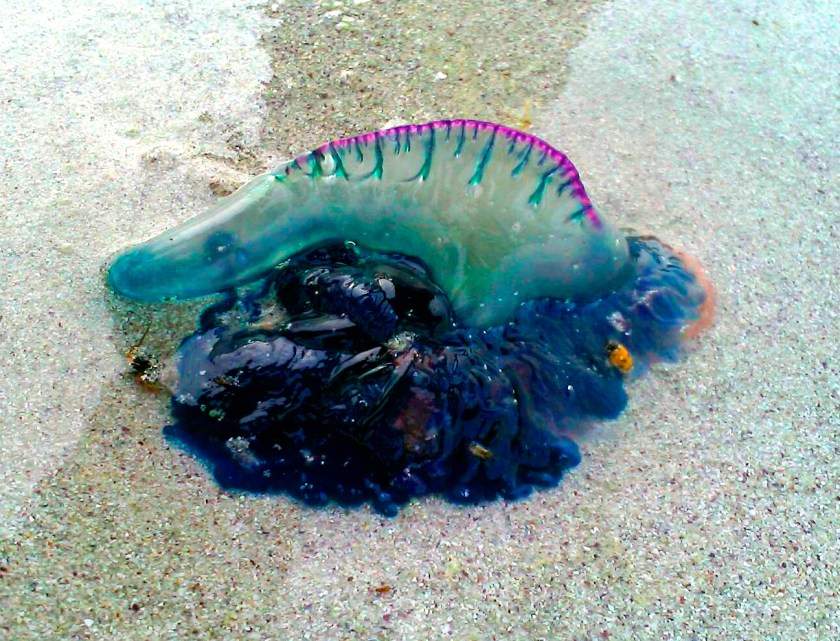
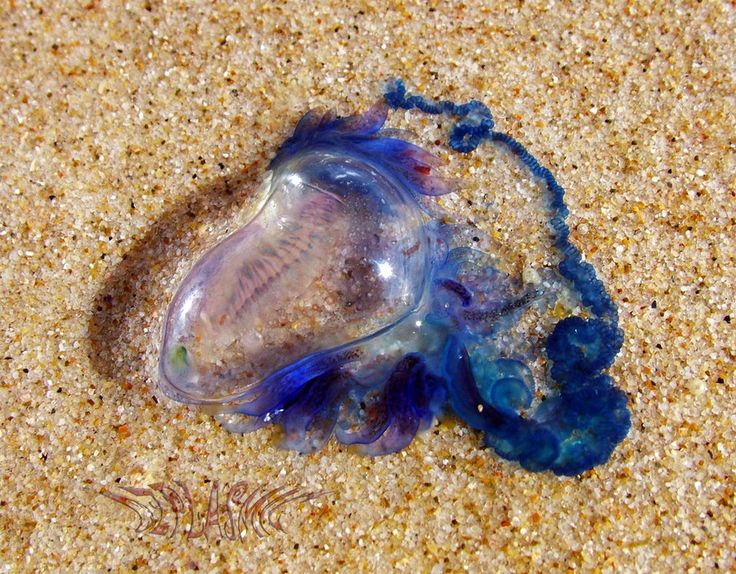
The Bluebottle or Portuguese Man-of-War is not a jellyfish but a colony of four kinds of animals which are dependent on one another for survival.
Short documentary here https://www.youtube.com/watch?v=2msRyMR2R08
The gas filled bladder allows it to float on the water, tentacles are used to capture and to the drag the prey up towards the mouth. On the east coast of Australia 10,000 to 30,000 stings per year are reported. In summer they are often found on beaches and coastal waters of Australia.
- A bluebottle sting usually causes an immediate and severe pain, which generally fades over about an hour.
- You can usually see where on the body the sting has occurred because there will be a red line where the tentacle has touched.
- Sometimes this line has a ‘beaded’ appearance, and is swollen and itchy.
- Occasionally blisters can develop at the site of the sting, and very rarely the sting will later cause scarring.
We were fishing in Darwin Harbor. Our fishing guide pulled in the anchor rope with a tentacle attached from a Bluebottle. He had a very painful sting that lasted about half an hour, as well as a welt that lasted all day. He said it was Very painful. We were careful touching our fishing lines after that.


 TOAL-Trip of a Lifetime